

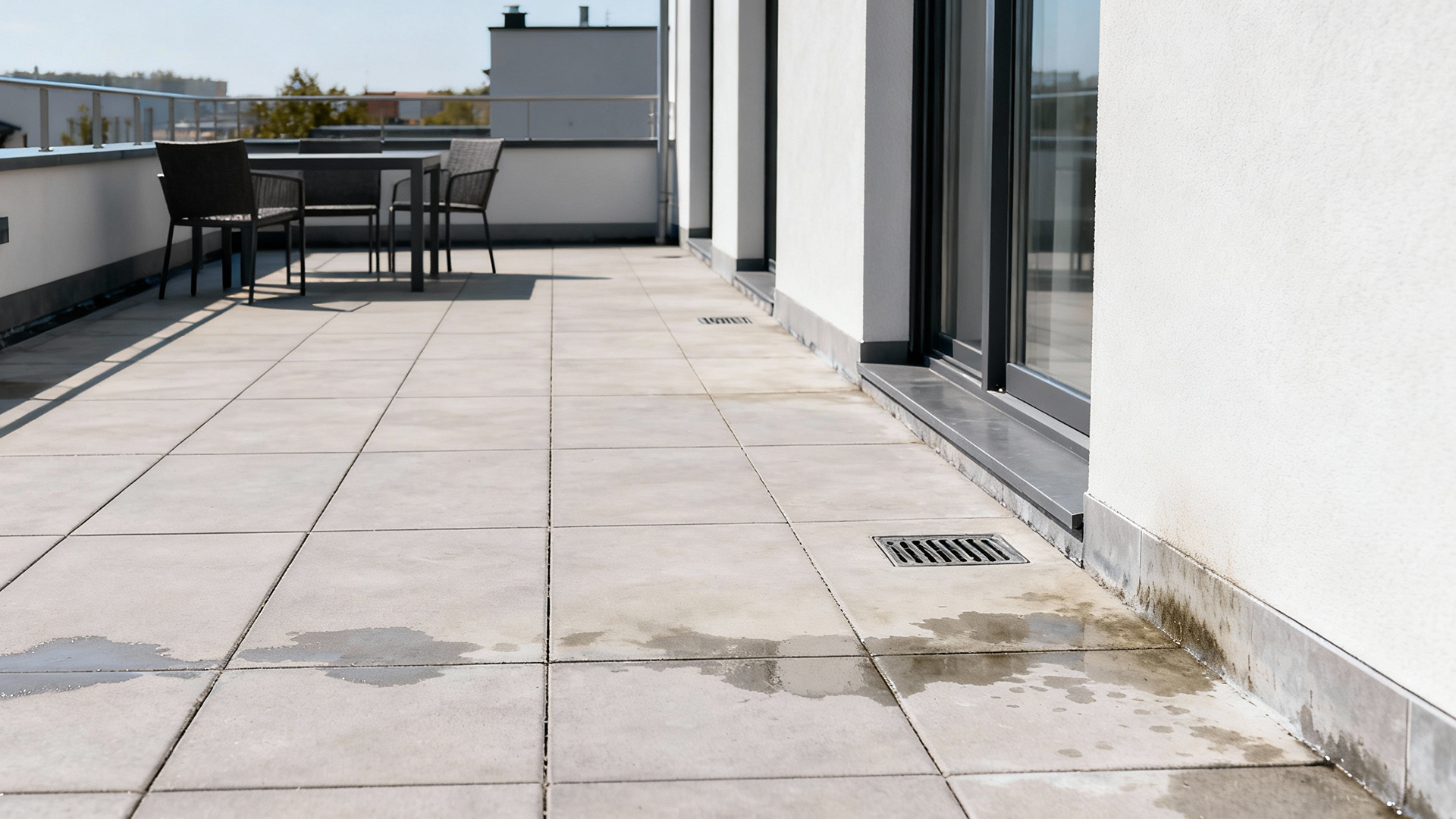
Balconies and terraces are among the most critical areas in terms of waterproofing, as they are directly exposed to external factors. Natural conditions such as rain, snow, and frost can cause serious waterproofing problems on the surfaces and joints of these areas. When balcony–terrace waterproofing is missing or incorrectly applied, water leaking into the structure can lead to moisture, mold, peeling, and deterioration of the reinforced concrete structure. In this article, we will provide an expert guide to the question “how is balcony waterproofing done?”, explain what to consider when solving terrace water leakage problems, and detail the correct application steps with DryFiX’s professional products.
Why Do Balconies and Terraces Leak?
Even the smallest mistake in waterproofing balcony applications can lead to significant costs later on. The main causes of leaks typically stem from application errors, incorrect product selection, or missing detail solutions. Here are the most common reasons:
Incorrect slope and poor water drainage If sufficient slope is not given to the balcony or terrace surface, rainwater accumulates, causing leaks and water damage to lower floors.
Cracked concrete surfaces Cracks that form on concrete over time allow water to seep inside—even hairline cracks can have major effects.
Water absorption through old or worn tile joints Ceramic coatings are not inherently waterproof. Worn-out joints allow water to pass underneath, causing deterioration in lower layers.
Failure to use waterproofing tapes at joints Corner and edge joints are the most vulnerable to structural movement. Not using waterproofing tapes in these areas leads to early failure of the waterproofing layer.
Incorrect product selection and single-coat application Materials used in outdoor areas must be UV-resistant, flexible, and durable against temperature differences. Single-coat applications do not provide sufficient protection. With products like DryFiX SB PLUS—applied in two coats and walkable—these issues can be prevented.
Essential Surface Preparation Before Waterproofing
Surface preparation is one of the most critical balcony waterproofing steps. Even the best material cannot perform well on a poorly prepared surface.
Removal of all loose materials Dust, oil, loose particles, and old coatings must be cleaned. The surface should be smooth yet receptive.
Crack repair with TRACK R2 Concrete cracks are a primary source of leaks. Repairing them with DryFiX TRACK R2 ensures a lasting solution.
Proper priming with PRIM-A or Binder 100 Before application, the surface must be primed to reduce absorbency and increase adhesion.
Professional Waterproofing Products for Balconies & Terraces
Choosing the right product is key for long-lasting waterproofing. Products must be UV-resistant, elastic, durable, and easy to apply. DryFiX offers multiple solutions:
Bitümer 100 2K — Strength against continuous water pressure Ideal for areas under constant moisture exposure.
MS Polymer 100 — Flexible, transparent or colored membrane Suitable under tiles and for UV-exposed areas.
IZOLATOR — Cost-effective and UV-resistant Provides practical application on large surfaces.
SB PLUS — Ideal under tile installations Walkable, elastic, and UV-resistant.
POLIUREA CO — High-performance seamless solution Used in large or professional project areas.
Correct Sealing of Edge & Joint Areas (Most Overlooked Step!)
Over 60% of leaks originate from joint areas.
Dilatation Tape — Manages structural movement
Corner Tape — Reinforces weak points
Water-Swelling Tape — Protects cold joints
PVC Waterstop — Ensures concrete joint security
Most Effective Application Order
- Surface repair
- Primer
- Band application at joint areas
- At least two coats of chosen waterproofing product
- Tile installation if needed
Common Waterproofing Mistakes
- Applying only one coat
- Not using tapes at joint areas
- Applying on wet surfaces
- Choosing incorrect products (UV–flexibility–tile suitability)
FAQ
How is balcony waterproofing done? Repair cracks → apply primer → seal joints → apply waterproofing in two coats → install tiles if required.
What is the best solution for terrace leaks? Products like DryFiX MS POLYMER 100 and IZOLATOR provide high UV and water resistance.
Which product should be used? SB PLUS if tiles will be installed; GLASSY 100 if no breaking of coating is planned.
Why is balcony waterproofing so critical? They are exposed to external weather conditions; poor waterproofing damages lower floors and weakens the building.